Opportunity Zone

The Water Bill Playbook: The Expense Line That Forces Appreciation

The Water Bill Playbook: The Expense Line That Forces Appreciation

The fastest margin lever most operators ignore is water. They’re leaking NOI. Here’s the playbook to cut utility spend and force appreciation.

The fastest margin lever most operators ignore is water. They’re leaking NOI. Here’s the playbook to cut utility spend and force appreciation.

Savoy Group

Created:

Feb 26, 2026

Last Updated:

Feb 27, 2026

The Expense Line No One Watches

Every apartment operator is hunting for margin right now. Rents are flat. Insurance is up. Taxes are up. Most owners stare at the revenue line and hope. The smart ones look at the expense line and act.

The first place we look—in good markets and bad—is the water bill.

Your water bill is not a fixed tax. It is a controllable variable. If your property shows usage over 200 gallons per unit per day, you are burning cash. We see deals in due diligence averaging 300 to 500 gallons. That is not old plumbing. That is system failure.

Most operators never see this. They're not in the building after close. They've handed off to a third-party manager who treats water as a pass-through expense—something to bill back to residents or absorb as a cost of doing business. They've hired a GC who bid the renovation but doesn't know what's actually failing inside the walls. And they've never operated enough units to see the variance: why one property runs at 180 gallons and another runs at 400 when the vintage and unit mix are nearly identical.

The only way to recognize water as a value creation lever is to be asset managing at scale and see the pattern across dozens of properties. The only way to know how to fix it is to have your own crews doing unit turns and seeing what's actually broken—not just old toilets, but deteriorating manifolds, angle stops that have been dripping for years, underground lines that spin the meter 24/7 without ever surfacing. The only way to know which fixtures to specify is to have installed enough of them to know what performs and what residents complain about.

This is what vertical integration actually looks like. Not a diagram. Not a pitch deck. A crew of eight plumbers who know exactly what to replace because we've seen the data from the other side.

The Target

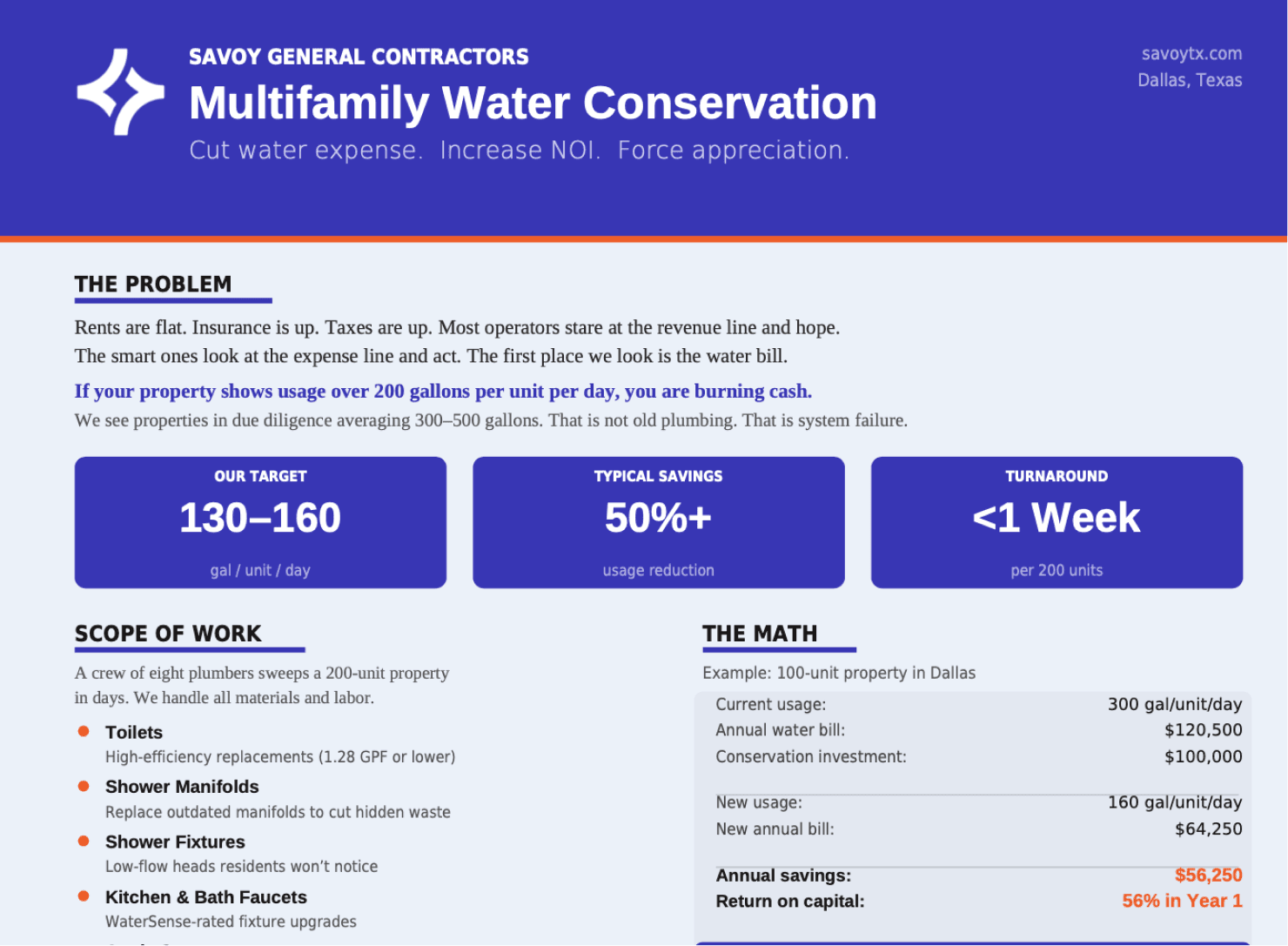
We aim for 130 to 160 gallons per unit per day. Hitting this number does not require a miracle. It requires a specialized crew and a checklist.

A crew of eight can sweep a 200-unit property in under a week. The scope is surgical: high-efficiency toilets, low-flow showerheads residents won't notice, WaterSense-rated faucets, and replacement of every angle stop that's been dripping quietly for years. We also hunt for underground leaks—the invisible ones that never surface but account for the single biggest source of waste on many properties. For older assets, we install individual building shutoffs so maintenance can isolate problems without killing water to the entire property.

The Math

Take a 100-unit property in Dallas.

Current usage: 300 gallons per unit per day. Annual water bill: $120,500.

We spend $100,000 on a full conservation sweep. Usage drops to 160 gallons per unit per day. New annual bill: $64,250.

Annual savings: $56,250. That is a 56% return on capital in year one.

But the savings are only half the story.

Real estate trades on a multiple of NOI. At a 6% cap rate, $56,250 in annual savings adds $937,500 to your asset value.

$100,000 in. $937,500 out.

The Point

In a flat rent market, this is how you force appreciation. Not by hoping for rent growth. Not by waiting for cap rate compression. By finding margin that others cannot see because they are not structured to see it.

We've run this playbook across our own portfolio and for third-party owners. At a 224-unit property in Arlington, we cut utility spend by 65% and recovered the full capital investment in eight months. The annual NOI improvement exceeded $200,000—double the original projection.

If you operate 100 or more units in Texas and want to find margin immediately, we will run the analysis, identify the waste, and execute the scope. You keep the equity.

Resource

Download the Water Playbook

Resource

Download the Water Playbook

Resource

Download the Water Playbook


Other resources

Audience

Content Types

Topic
Owners

Blog

Renovation

The Headline Was the Foreclosure. The Real Story Was the Rebuild.

The foreclosure made news. The rebuild required security, evictions, construction, and unified execution. Here is how vertical integration stabilized 844 units and rebuilt value from 23 percent occupancy.

Learn more

Developers

Blog

New Construction

The $858,000 Fire Code Line Item Your GC Never Questioned

Most developers never question the line items their GC prices. Here is how treating an $858,000 fire code requirement as a policy issue protected returns and kept a Texas deal alive.

Learn more

Developers

Blog

New Construction

Renovation

Opportunity Zone

You Can't Reposition a Neighborhood with One Building

One building does not shift a market. Here is how concentrated ownership, internal construction, and integrated property management repositioned nearly 1,000 units across five years.

Learn more

Owners

Blog

Opportunity Zone

New Construction

The Year 1 Tax Benefit That Funds Itself 131 Times Over

Most investors understand depreciation in theory. Here is how a cost segregation study accelerated $3.7 million of basis and generated $656,000 in first-year tax savings.

Learn more

Owners

Blog

Renovation

Two Buildings, Same Neighborhood, 2.3x the NOI: The Case for Gut Renovation

Two identical-size buildings in the same neighborhood delivered radically different results. Here is how deeper renovation scope reduced expenses, stabilized performance, and doubled NOI.

Learn more

Owners

Blog

Property Management

Tenant Fraud Isn't Bad Luck. It's a Pattern with a Fix.

Fraud is not bad luck at scale. Here is how managing 6,000 units exposed an $8,000 per-tenant risk and how stricter screening reduced operating losses.

Learn more

Owners

Blog

Renovation

The Headline Was the Foreclosure. The Real Story Was the Rebuild.

The foreclosure made news. The rebuild required security, evictions, construction, and unified execution. Here is how vertical integration stabilized 844 units and rebuilt value from 23 percent occupancy.

Learn more

Developers

Blog

New Construction

The $858,000 Fire Code Line Item Your GC Never Questioned

Most developers never question the line items their GC prices. Here is how treating an $858,000 fire code requirement as a policy issue protected returns and kept a Texas deal alive.

Learn more

Developers

Blog

New Construction

Renovation

Opportunity Zone

You Can't Reposition a Neighborhood with One Building

One building does not shift a market. Here is how concentrated ownership, internal construction, and integrated property management repositioned nearly 1,000 units across five years.

Learn more

Owners

Blog

Opportunity Zone

New Construction

The Year 1 Tax Benefit That Funds Itself 131 Times Over

Most investors understand depreciation in theory. Here is how a cost segregation study accelerated $3.7 million of basis and generated $656,000 in first-year tax savings.

Learn more

Owners

Blog

Renovation

Two Buildings, Same Neighborhood, 2.3x the NOI: The Case for Gut Renovation

Two identical-size buildings in the same neighborhood delivered radically different results. Here is how deeper renovation scope reduced expenses, stabilized performance, and doubled NOI.

Learn more

Owners

Blog

Property Management

Tenant Fraud Isn't Bad Luck. It's a Pattern with a Fix.

Fraud is not bad luck at scale. Here is how managing 6,000 units exposed an $8,000 per-tenant risk and how stricter screening reduced operating losses.

Learn more

Owners

Blog

Renovation

The Headline Was the Foreclosure. The Real Story Was the Rebuild.

The foreclosure made news. The rebuild required security, evictions, construction, and unified execution. Here is how vertical integration stabilized 844 units and rebuilt value from 23 percent occupancy.

Learn more

Developers

Blog

New Construction

The $858,000 Fire Code Line Item Your GC Never Questioned

Most developers never question the line items their GC prices. Here is how treating an $858,000 fire code requirement as a policy issue protected returns and kept a Texas deal alive.

Learn more

Developers

Blog

New Construction

Renovation

Opportunity Zone

You Can't Reposition a Neighborhood with One Building

One building does not shift a market. Here is how concentrated ownership, internal construction, and integrated property management repositioned nearly 1,000 units across five years.

Learn more

Owners

Blog

Opportunity Zone

New Construction

The Year 1 Tax Benefit That Funds Itself 131 Times Over

Most investors understand depreciation in theory. Here is how a cost segregation study accelerated $3.7 million of basis and generated $656,000 in first-year tax savings.

Learn more

Owners

Blog

Renovation

Two Buildings, Same Neighborhood, 2.3x the NOI: The Case for Gut Renovation

Two identical-size buildings in the same neighborhood delivered radically different results. Here is how deeper renovation scope reduced expenses, stabilized performance, and doubled NOI.

Learn more

Owners

Blog

Property Management

Tenant Fraud Isn't Bad Luck. It's a Pattern with a Fix.

Fraud is not bad luck at scale. Here is how managing 6,000 units exposed an $8,000 per-tenant risk and how stricter screening reduced operating losses.

Learn more

Build with Certainty

Unlock Infinite Leverage with Savoy

Savoy combines three specialized divisions—Savoy Equity Partners, Savoy General Contractor, and Savoy Residential—under one roof, designed to deliver predictable execution, tighter budgets, and superior returns through a closed feedback loop.

Build with Certainty

Unlock Infinite Leverage with Savoy

Savoy combines three specialized divisions—Savoy Equity Partners, Savoy General Contractor, and Savoy Residential—under one roof, designed to deliver predictable execution, tighter budgets, and superior returns through a closed feedback loop.